What does it mean that ‘…the natural man is an enemy to God’? (Mosiah 3:19)
I’ve been pondering on this subject for a fair while and I somehow doubt I will be able to do it justice, but I’m going to try anyway. The passage from King Benjamin’s speech to his people is oft-quoted in LDS talks and lessons. We tend to focus on the latter half of the verse, where Benjamin tells us how to put off the natural man. That will unfortunately have to wait for another post, because there’s more going on there than we usually discuss, but I want to start with defining the natural man. Because if we get that part wrong, it can have incredibly damaging consequences for how we view ourselves.
It’s probably useful to go back to the beginning. When God created people1, in Genesis, He said that they were created in His likeness and image (Genesis 1:26-27). Granted, this is pre-fall, before Adam and Eve partake of the forbidden fruit, but it gives us a useful key in looking for what is god-like.
When God completes the initial creation narrative in Genesis 1, He calls His creation ‘very good’ (Genesis 1:31). Up to now, everything God has created is ‘good’. The idea of good coming from God and evil coming from (post-fall) humans is a theme throughout these early chapters of Genesis and that is worth emphasising. Good comes from God – that is ALL He creates. God is good, (Psalm 73:1, 1 Timothy 4:4) and at the end of Genesis 1 it is called very good. The Hebrew for ‘very’ can also be translated as ‘vehemently’ or ‘wholly’, so the author is really emphasising the goodness God has made for us.
As we next read through the Eden narrative pre-fall, let’s notice some of the characteristics of these ‘very good’ living humans God has created. They are ‘not ashamed’ (Genesis 2:25). They are trusting (Eve simply believes the serpent). They have taste. They sought wisdom.
We also learn that every tree in the garden in which God has place them is good for food and is desirable to the eyes (Genesis 2:9). The King James Version says ‘pleasing’ to the eyes, but we’ll shortly see a very different Hebrew word also translated as ‘pleasing’ and it’s important to note the difference. That’s why I use ‘desirable’ here.
For now, let’s just notice that every tree is good for food, and every tree is desirable to the eyes, and that is good. Not only that, but with the exception of one tree, Adam and Eve are told to partake of all of them. We’re here learning that desires aren’t bad – in fact, they’re good. God wants us to partake of the many, many good things he has created for us on this earth. Our bodies were created in His image, and we’re supposed to desire the good things of the earth and partake of them. When it isn’t going to be good for us, God will tell us – in the Garden narrative, that is represented by the Tree of Knowledge of Good and Evil.
As I say, the whole idea of the contrast between good and evil is really important in the early chapters of Genesis. Everything God has done up to now has been good. Evil will be introduced later and we’ll see the impact of that on living humans.
We are often taught in sermons and Sunday Schools that physical desires are wrong and should be suppressed, but here in Genesis, as part of what God has called ‘very good’ we find living humans feeling desires.
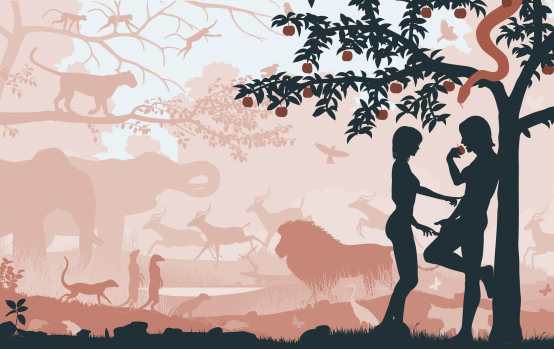
It’s now that the serpent comes along and deceives Adam and Eve. He tells them a truth (the fruit of the Tree of Knowledge of Good and Evil will make you wise), and a lie (you will not die), and because Adam and Eve2 are naive like children, they believe him and eat, but notice the wording.
The King James Version reads, ‘And when the woman saw that the tree was good for food, and that it was pleasant to the eyes, and a tree to be desired to make one wise…’ (Genesis 3:6). Eve notes that the fruit is good for food, just as we learn in Genesis 2:9. The Hebrew for ‘desired’ is the same as used for ‘pleasant’ in Genesis 2:9, so again we see the recognition of what we already know.
The key difference here is that it is also ‘pleasant to the eyes’. While the King James translation makes this phrase indistinguishable from Genesis 2:9, the Hebrew is very different. The Hebrew is ta’awah, elsewhere in the Bible translated as greed or lust. So here we see something new – a physical craving or longing.
No doubt Adam and Eve had seen the tree before. They had noticed it was good for food and desirable to look at – both things God had created for it. But now, listening to Satan, they saw and felt something new. They had apparently never felt that craving. It was only now that they were listening to the serpent that they looked at the fruit of the tree and felt a greed or craving for it, and that caused them problems.
But even after Adam and Eve eat the fruit and God calls them out on it, He never tells them off for these cravings. I find that fascinating. It is also only after they have partaken of the forbidden fruit that they feel shame – and then it’s not God who shames them. In the LDS tradition, it is Satan who points out to Adam and Eve that they are naked and tells them to hide. It is Satan who shames them. That leads them to being afraid of appearing before God (Genesis 3:10). This is how God identifies that Adam and Eve have eaten the fruit – shame and fear of being before Him isn’t something they should be feeling.
I find it really interesting that religious leaders and teachers teach shame and fear about some of these attributes that God called very good. Physical desires aren’t bad – at least not according to Genesis. Indeed they are a part of being in the image and likeness of God. In contrast, fear and shame come when we hearken to the words of Satan.
Now let’s take a step back and try and apply this to the ‘natural man’ that is so terrible – the one that is an enemy to God.
Because we’re made in the image and likeness of God, our natural desires aren’t bad; they’re not evil. In fact, our natural desires are part and parcel of what it means to be in the image and likeness of God. They are good, because everything God created was good – even very good. And He wants us to see the good and the desirable and to partake, to enjoy what He has given to us in this life. So the ‘natural man’ doesn’t equal ‘natural desires’. This, I think, is where we mess things up, because we conflate the two things.
But the Lord also given us some warnings. Some things aren’t good for us to partake of – indeed, partaking of them will lead to a spiritual death. The fruit from all the trees in the garden were fantastic for eating, except for one. Similarly, we should look to experience and enjoy life, mindful of the comparatively few things God warns us about. Let’s use a couple of the Ten Commandments as examples.
God knows that, ‘…it is the nature and disposition of almost all men, as soon as they get a little authority, as they suppose, they will immediately begin to exercise unrighteous dominion.’ (D&C 121:39) Authority might be running a country, or a company, or a team, or a religion, or a church congregation. Or it might be becoming an expert in a subject, or being so physically attractive that others naturally defer to you. Or it might be fame, or earning so much money that people look up to you as a success or so that you can even ‘buy’ your way out of trouble.
There are a myriad of ways we can gain ‘authority’ in this life and start to think of ourselves as more important than others. And as soon as we gain that authority, we start to think of ourselves as better than others. Inequality born of pride is the great sin of the Book of Mormon and the Old Testament. So when the Lord tells us that we should not bow down to anything or anyone other than Him (Exodus 20:5), He is warning us against acting on these ‘cravings’. Satan will come along and give us a thousand reasons why there’s actually nothing wrong with doing so – ‘You should be in charge, because …’ – but if we’re truly wise, we’ll heed God’s warning. We mustn’t bow down to fame, or money, or education. If we seek first the kingdom of God, all other necessary things can and will be added as and when we need them (Matthew 6:33).
Another commandment is that we shouldn’t covet (Genesis 20:17). There is nothing inherently wrong with being wealthy. There is nothing wrong with nice cars or good quality clothes. But as Jacob teaches, ‘… ye will seek [riches] for the intent to do good—to clothe the naked, and to feed the hungry, and to liberate the captive, and administer relief to the sick and the afflicted.’ (Jacob 2:19) So, if we have the biggest house, and the nicest car, and the most luxurious clothes, all the while ignoring the poor and the vulnerable, that’s a problem. If we see an ad for the latest iPhone and think, ‘I’ve got to have that!’, that’s a problem. We’re giving in to our cravings – the very things God has warned us about. In some ways coveting could be seen as giving ourselves permission to have those very cravings Genesis warns us against. We are bowing down to gods of wealth and status.
Another example is so-called ‘purity culture’, which can be hugely problematic in religion. Sexual sin is serious in the scriptures, and because sexual desire is felt pretty strongly by a lot of people, men running religion have built a lot of rules surrounding it. As a teen in my LDS faith, I was never taught that sexual desire was, itself, good. Instead, I was taught how bad it was. How even thoughts were as bad as any actions. So as a teenager with normal hormone development I was constantly beating myself up and telling myself what a terrible person I was. It’s easy to find members and former members of a whole host of Christian religions who throughout their adult lives continue to carry an enormous amount of shame around sex even within their marriage because of what they were taught as teenagers. I don’t believe the Lord is pleased when we call evil, what He declared was good.
Remember, shame doesn’t come from God. It comes from Satan. In the Garden, it was Satan who gave Adam and Eve the idea of shame. Shame pushes us away from God, not towards Him. Recall, there is nothing wrong with desire – desire is good. It is craving and greed that is the problem. Sexual desire isn’t wrong, it’s good. It’s positive, and fulfilling that sexual desire is something God wants us to experience. It should be a positive and beautiful experience. He’s told us how that desire should be fulfilled if we want to be His covenant people (within marriage), and thus given us a, ‘Thou shalt not commit adultery,’ commandment (Exodus 20:14) – in this context that commandment is the Tree of Knowledge we’re not to partake of.
So, when we read, ‘…the natural man is an enemy to God…’ (Mosiah 3:19), we shouldn’t be thinking, ‘sexual desires are bad’, or ‘wanting chocolate is bad’, or ‘I’m so terrible for wanting to sleep in’, or ‘It’s awful that I wish the sermons at church were better’, or ‘I must be greedy because I wish I had more money.’ None of these things is inherently bad.
What the Lord warns us about is giving in to cravings for things of the flesh. If food becomes the god I worship, then that’s a problem. If sex is what I pursue above all else, that’s a problem. If what I primarily chase is more and more money, then that’s a problem.
Of course, our bodies are built so that when we get a physical or emotional reward, we get a hit of dopamine in our brains and we’ll be more inclined to seek the same behaviour again, so it’s something we need to watch out for, for sure. If one piece of chocolate is good, two pieces are better. And why not a third? The next day it’s four, and then five, and so on. Until our bodies are overweight and chronically ill. Sometimes, moderation is good and excess is bad.
Whether ‘the fall’ literally happened or whether it’s an allegorical story, God seems to know that chasing the next dopamine hit is something we’ll be inclined to do, and that is bad news for us: ‘…that old serpent that did beguile our first parents, which was the cause of their fall; which was the cause of all mankind becoming carnal, sensual, devilish, knowing evil from good, subjecting themselves to the devil.’ (Mosiah 16:3)
So God tells us to look after our bodies. Eat food that is natural and healthy for us and watch out for the fruit from trees from wicked and designing men (D&C 89:4) who are creating Trees of Knowledge that God is warning us about. If we slip up, don’t cover ourselves up fig leaves in shame, but go straight to God. Just as God made coats of skins for Adam and Eve when they had to leave the Garden of Eden, so He will also cover us. Did you know that the Hebrew word translated as ‘atonement’ in English (kippur), actually more accurately means ‘to cover’? Yes, when God covers Adam and Eve, He is teaching us that the lamb slain from the foundation of the world (Revelation 13:8) will cover us.
When Paul says, ‘…the natural man receiveth not the things of the Spirit of God: for they are foolishness unto him…’ (1 Corinthians 2:14), he’s not saying it’s impossible to know God if we have any normal, natural desires. He’s teaching that if we prioritise the next dopamine hit, or whatever worldly thing it is we think will save us, instead of God and His saving power, we won’t be able to understand the things of the Spirit.
Alma said something similar: ‘And now behold, my brethren, what natural man is there that knoweth these things? I say unto you, there is none that knoweth these things, save it be the penitent.’ (Alma 26:21)
It’s not the ‘stuff’ of this world that causes problems – many of those are neither good nor bad. It’s not desires that come naturally to our bodies and minds and emotions – those are good, remember, and are part of what makes us in the image and likeness of God. It’s what we really, really pursue. Has a desire got such a hold on us that we’re craving it, lusting after it, are greedy for it? If so, then there’s fruit from a tree we probably shouldn’t have partaken of.
No worries, go back to God. Repent (mean it). Let Him cover you. There is more to say on this of course, but it will have to wait. In advance of a post about that, let me just leave you with the words of Peter, who said it so beautifully:
‘According as his divine power hath given unto us all things that pertain unto life and godliness, through the knowledge of him that hath called us to glory and virtue: Whereby are given unto us exceeding great and precious promises: that by these ye might be partakers of the divine nature, having escaped the corruption that is in the world through lust.’ (1 Peter 1:3-4)
© Copyright Jeffrey Collyer 2026
- The word Adam in Hebrew is non-gendered and is more of a generic person. In olden-times, the English word ‘man’ meant more of a generic ‘mankind’ rather than male. This is why in some modern translations, ‘humanity’ is used instead of ‘man’ – it more accurately reflects what the author of Genesis meant to a modern audience. Alongside this, Eve means ‘living’. So when we read that God made Adam and Eve, we are literally reading that God made living humanity. This can be a highly instructive way to read the Eden narrative, certainly as opposed to any intended gender differences (which the author probably didn’t have in mind), and even as opposed to the literal creation of the first humans on earth. The ancient Hebrew simply didn’t think that way.
- Yes, I know it is Eve who is deceived. But in this particular instance each of us – male and female – are represented by Eve. We all succumb to deception, so I’ve used ‘Adam and Eve’ to try and avoid any gendered criticism.
 All Things Witness