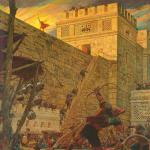
One of the YouTube channels I follow is Connor Boyack. For those who don’t know him, Connor is a fairly well-known commentator and activist in Utah, probably of a more Libertarian bent, and active member of the Church of Jesus Christ of Latter-day Saints (LDS). Sometimes I agree with him, and sometimes I disagree but I usually find his ‘Sunday musings’ well thought-out and researched.
Yesterday, he entitled his musing ‘What would a modern Samuel the Lamanite sound like?’ You can watch his musing here.
The story of Laban and his sword in the Book of Mormon has long fascinated me. For many, it’s a problematic story, because Nephi cuts off Laban’s head with his own sword, as commanded by the Spirit and, well, that sort of thing is more likely to be a sign of mental illness in our days and times. So, I get that.
But I think we’ve long misinterpreted this passage and today I’d like to perhaps recast this tale and hopefully help us to all understand it in a new light.
First off, it’s probably worth emphasising a couple of things. One, although told in narrative story form, Nephi isn’t writing in order to tell us a story. He is teaching us about how to come to Christ. He is most explicit about this effort in 2 Nephi, but it’s the same message in 1 Nephi – just expressed differently.
I find that some of the most tender scenes in the scriptures are when Jesus is with children. For Latter-day Saints, perhaps the scene in the Book of Mormon when Christ visits the people after his resurrection comes to mind.
‘Blessed are ye because of your faith. And now behold, my joy is full. And when he had said these words, he wept, and the multitude bare record of it, and he took their little children, one by one, and blessed them, and prayed unto the Father for them. And when he had done this he wept again; And he spake unto the multitude, and said unto them: Behold your little ones. And as they looked to behold they cast their eyes towards heaven, and they saw the heavens open, and they saw angels descending out of heaven as it were in the midst of fire; and they came down and encircled those little ones about, and they were encircled about with fire; and the angels did minister unto them.’ (3 Nephi 17:20-24)
Any parent would desire such a blessing for their children.
In my last post, I talked about one way to interpret the writings of Nephi in the Book of Mormon is to assume that the characters of Laman and Lemuel represent you and me. Remember, they were always obedient to the Law of Moses – Nephi never once calls them out on that. They were also just like the majority of the Jews at Jerusalem – those who were about to be destroyed because of their wickedness (see 1 Nephi 2:13).
Although this approach makes us feel uncomfortable – after all, none of us likes to believe that we are included amongst the wicked – it causes some deep introspection and self-examination. We start to look more closely at how Nephi describes his older brothers. If he never criticises them for their approach to the Law of Moses, when does he call them to repentance?
Last year I returned home for first time in over 40 years. You see, home for me is Australia. It’s where I was born and raised for the first 12 years of my life. While I’m now well into my 50’s and sound like a proper pom, my heart has always remained down under.
That visit home was very special in so many ways, not least because I was able to spend loads of time with my older brother Tony and his very special family. He and I are like chalk and cheese. We really are polar opposites in almost every way – we don’t even look anything alike. In fact, a common question we were asked was, ‘Are you really brothers?’
There are so many things I love about the gospel of Jesus Christ. One of these is how so many principles overlap, complement and enhance each other; and how things that we might have heard many times before can suddenly take on new meanings, or sometimes just become so much more important than they once were.
I was struck a few months ago by something someone said. I don’t remember where I came across it – it might have been a blog post, or a Youtube video, or a General Conference talk or something else entirely – so I apologise of the lack of attribution. I don’t even remember the actual quote, but I remember the reference and the impact.
Many years ago in another part of the world, I was serving in a calling that required me to be in contact with many church leaders around the Stake. On a particular Sunday evening, I needed to make contact with several individuals and picked up the phone (this was before the days of mobile phones, text messaging and the internet). I specifically recall ringing one house, where the Bishop I spoke to was very polite on the phone. In the background, however, I heard a member of his household say, ‘What’s he doing ringing you now? Doesn’t he know the World Cup final is on?’
This continues the series discussing the LDS ordinance of the sacrament. To see the previous posts in the series, see here
As we continue our pondering of the Sacrament prayer wording, it’s important to pause and consider in some detail the Name of Christ. In the prayers, the Priest asks, ‘God the Eternal Father … in the name of thy Son, Jesus Christ…’ to bless and sanctify the sacramental emblems. It’s easy to overlook this, because in the LDS Church we close every prayer, every testimony, every talk/sermon, every lesson, ‘in the name of Jesus Christ, Amen’. It’s become a custom, one could almost say a habit.
That’s unfortunate, because there is great power in the Lord’s Name, and we miss out on that when we’re not deliberate and reverent. Indeed, we may well be breaking the third of the great commandments given at Sinai, ‘Thou shalt not take the name of the Lord thy God in vain…’ (Exodus 20:7). It’s this commandment I’d like to focus on in this post.
Twice a year, members of the church from the wider area where we live gather together for what we call ‘Stake Conference’. The conference is held over Saturday and Sunday, and I was asked to speak at the session held last night. I share it here in the hopes that it provides some hope and understanding for others.
***
Many years ago, I served my mission amongst the beautiful people of Chile. For the last couple of weeks, I’ve been thinking about a particular experience I had while I was there.
I was in a small town called Coihueco. And my companion and I were teaching a single mother and her daughter who I’ll call Juana, who was about 12 years old. They lived on the outskirts of the town in a small makeshift house of dirt floors. Continue reading →
This post continues my series on the Sacrament. And don’t worry, I’ll get to it. But there’s something important (and surprisingly relevant) I need to discuss first.
As you might know, I’m LDS. If you’re not LDS – or perhaps don’t even know what that means – you might know members of our church as Mormons.
When the church was newly organised back in the early to mid 19thcentury, the term Mormon was used first by enemies of the church and was considered derogatory. But over the years, the word became more widespread. Continue reading →