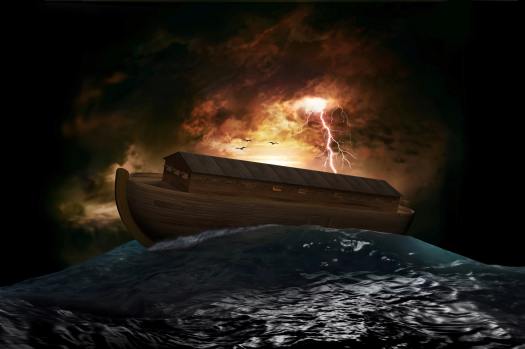
‘Follow the Prophet’. Since its inclusion in the Primary songbook in the 1990’s this has become a refrain heard repeatedly in the Church of Jesus Christ of Latter-day Saints. The song was commissioned by the Church, the writer asked to write something about Old Testament prophets that children would enjoy.
I recall with a smile on my face our many times singing this with our children when they were little, marching around our living room furniture, ‘Follow the prophet, he knows the way …’, and still find the lyrics curiously amusing that the people of Noah’s day didn’t listen to him because they were, ‘busy sinning’.
The question is, though: is the mantra true? What does it mean?
On the one hand, it’s easy to say, ‘Of course it’s true – if the people had followed Noah rather than being so busy they would have been spared drowning in the flood.’ But the scriptures themselves never use the phrase ‘follow the prophet’. Why? Because true prophets of the Lord never say, ‘Follow me’; they say instead, ‘Follow God’.
That might seem like semantics, but it’s important. In the opening chapters of the Book of Mormon, Lehi is called as a prophet and he leaves Jerusalem with his family at the command of the Lord. His son, Nephi, prays and is told that his father’s prophecies are true. But a few chapters in, as the family faces starvation in the desert, Lehi himself begins to murmur and complain against the Lord. Here, Nephi doesn’t, ‘follow the prophet,’ but instead admonishes his family, including his ‘prophet’ father. He still respects Lehi’s position as head of the group and asks him where he should go for food – but he didn’t follow him in complaining, because Lehi himself wasn’t following the Lord in doing so. If Nephi had followed the example of ‘the prophet’, he too would have murmured and the whole family would likely have died of starvation – yes, Lehi was leading the family astray at that moment.
When we look to the same period in the Old Testament, we see Jeremiah as the prophet telling the people to repent. But he was no ‘official’ prophet. He was called directly by God, but wasn’t part of the ecclesiastical structure. The ecclesiastical ‘prophets’ were telling the Jewish King and the people that they would be fine because they were righteous. Oops…
The prophet Joseph Smith said, ‘A prophet is only a prophet when acting as such.’ (History of the Church, 5:265) In other words, just because someone (man or woman) is a ‘prophet’, it doesn’t mean that every minute of every day they’re being ‘prophetic’. It doesn’t mean that everything they do is what the Lord expects us to be doing. It doesn’t mean that everything they say is as if God Himself were speaking. We need only look at the history of the Church (any church to be honest), to learn of many instances when so-called prophets have said things – even ‘in the name of the Lord’, that were plain wrong.
In the LDS church think of Brigham Young and his doctrines of blood atonement, Adam-God or his racial ban on Priesthood – all of which he taught were revelations from God. If we believe those teaching weren’t true (and Church leaders have officially condemned some of them), then in those instances he was leading the people away from Christ.
Even Moses in ancient Israel was refused permission to enter the Promised Land because he had disobeyed God while doing something specifically commanded of Him. (See Numbers 20:8-11)
None of these instances prove that Lehi, Moses or Brigham Young weren’t ever acting as prophets. They demonstrate only that there were certainly times, even potentially when claiming that they were acting in His name, that they acted instead from their own fallen natures. Blindly following any arm of the flesh – even a so-called prophet – means that inevitably we will at some point be led astray.
Of course, at the same time, Brigham also taught people the importance of faith in Christ, baptism, temple ordinances, the importance of obtaining and following the Holy Ghost – all of which draw people towards Christ. Brigham Young himself taught people that they shouldn’t blindly follow him or any leader of the Church, but that each and every person should obtain their own testimony of truth.1
It’s why I personally feel incredibly uncomfortable when a talk in LDS General Conference focuses on ‘following the prophet’. I obviously don’t object to President Nelson crushing his empty plastic water bottle so it doesn’t take up so much room in the rubbish bin, or others copying him, but that’s because it’s probably a good idea – not because President Nelson did it and he’s ‘the prophet’ so we should follow him.2 In practice, I probably wouldn’t crush my water bottle, because I have constant pain in my fingers and hands and it would hurt to do so. Thankfully, because I don’t believe this suggestion is prophetic, I don’t need to feel guilty about that.
To be honest, I don’t even really like calling President Nelson ‘the prophet’. He is called as a prophet, seer, and revelator – as are his two counsellors and members of the Quorum of the Twelve Apostles – but that is a calling. Any time the Lord calls any of us to any calling (I’m not talking just about callings in the Church here), it is for us to then step up to that. Sometimes we do that, sometimes we don’t.
‘Behold, there are many called, but few are chosen.’ (D&C 121:34) This is a principle that applies everywhere God calls mortals. I believe President Nelson does act as a prophet, and I sustain him as such, but I don’t believe he is prophetic in everything he says or does.
This leads to the obvious question as to how we know when someone is acting as a prophet, but before I address that I want to take a side-track here for a minute and talk about the Apostles more generally. This is something I’ve been pondering for many, many years and links with the the posts I’ve written about taking upon us the name of Christ.
As discussed, the Apostles today (from whom will come the future Presidents of the Church and their Counsellors) are all called as prophets, seers, and revelators. But there is another title they receive which I believe is at least as important. That is ‘special witnesses of the name of Christ.’ (D&C 107:23)3
I’ve previously talked about some of the meanings behind our taking upon ourselves the name of Christ. In connection with that, this title of our modern Apostles is really interesting. What does it mean?
Most sincere Christians would consider that they have some degree of responsibility and/or desire to be a witness of Christ ‘… at all times and in all things, and in all places that [we] may be in …’ (Mosiah 18:9), but witnessing the name of Christ? And not just being a witness, but a special witness?
When the first Quorum of Twelve Apostles was called in this dispensation in 1835, they were given a special charge by Oliver Cowdery. Part of that charge is as follows:
‘…it is necessary that you receive a testimony from heaven for yourselves; so that you can bear testimony to the truth of the Book of Mormon, and that you have seen the face of God. That is more than the testimony of an angel. When the proper time arrives, you shall be able to bear this testimony to the world. When you bear testimony that you have seen God, this testimony God will never suffer to fall, but will bear you out; although many will not give heed, yet others will. You will therefore see the necessity of getting this testimony from heaven.
‘Never cease striving until you have seen God face to face. Strengthen your faith; cast off you doubts, your sins, and all your unbelief; and nothing can prevent you from coming to God. Your ordination is not full and complete till God has laid His hand upon you. We require as much to qualify us as did those who have gone before us; God is the same. If the Savior in former days laid His hands upon His disciples, why not in latter days?
‘…You have our best wishes, you have our most fervent prayers, that you may be able to bear this testimony, that you have seen the face of God. Therefore call upon Him in faith in mighty prayer till you prevail, for it is your duty and your privilege to bear such testimony for yourselves.’ (History of the Church, 2:194-198, emphasis added)
Based on this quote in one sense I therefore believe that one essential way in which modern-day Apostles are to be ‘special witnesses’ of the name of Christ is that they have fulfilled that charge and been in His presence. Have each of them fulfilled this charge? I have no idea. Brigham Young publicly declared that he hadn’t.4 On the principle of ‘many are called but few are chosen’, I suspect some have and some haven’t. However, they don’t talk about it so we don’t know, but it is always worth paying very close attention to them when they bear Apostolic witness. The Apostle John teaches us that, ‘… the testimony of Jesus is the spirit of prophecy.’ (Revelation 19:10)
I believe there is also another way in which they serve as ‘special witnesses of the name of Christ’, and this relates back to our own covenants.
The Lord declared that the responsibility of the Twelve Apostles, assisted by the Seventy, is in ‘building up the church and regulating all the affairs of the same in all nations,’ and ‘holding the keys, to open the door by the proclamation of the gospel of Jesus Christ…’ (D&C 107:33-35) Baptism by water is the gateway into the Church and is also the first step we make in taking upon ourselves the name of Christ. Consider this, the Apostles are special witnesses of, and we take upon ourselves, the name of Christ. In other words, the Apostles are to witness the very thing we must take upon ourselves – Christ’s name.
This is why our twice-annual General Conferences are so important. As the Lord’s covenant people, we have an opportunity to listen to those special witnesses bear both their own testimonies of Jesus Christ, as well as to witness to us the way in which we should be taking upon ourselves His name. Inasmuch as truths are declared by them and followed by us, we will draw closer to Christ as a result.
To properly understand this is electrifying. If we did, we would never miss another session of General Conference.
Now, do all of the General Authorities of the Church always fulfil this responsibility? This brings us back to the question of whether a prophet is always speaking as a prophet. Must we all crush our empty plastic water bottles in order to more fully take upon ourselves the Lord’s name? No, of course not. Are false doctrines sometimes taught in General Conference? History tells us yes. Do we therefore throw the whole lot out? Not at all! As long as imperfect mortal men (and women) teach, there will be some combination of truth and error. My testimony is that there is more truth than error.
So, how to we deal with this? If we really must listen to those whose calling it is to tell us how we can more fully take upon ourselves the Saviour’s name, but only when they’re actually speaking prophetically, how can we know?
That’s what the Holy Ghost is for, ‘…by the power of the Holy Ghost ye may know the truth of all things.’ (Moroni 10:5)
So, we head into General Conference (and as we later read and study those talks) in prayer and seeking the companionship of the Holy Ghost, sincerely searching for those truths that the Lord would have us apply in our lives. Doing so will open our hearts and minds and we can receive the direction we need. We will do so. Seek and ye shall find.
President Nelson has given us some truly prophetic utterances and discourses in recent years. We would be foolish not to listen very closely to him and prayerfully consider his words. To not do so could have devastating consequences.
Ultimately, however, the Lord isn’t aiming for us to have a personal relationship with ‘the prophet’ – He is seeking a personal relationship with us individually. He wants to communicate directly to each of us. At the great and final judgment bar, there will be no middleman between us and our Advocate. True prophets show us the way to achieve that closeness. Let’s follow that direction.
© Copyright 2025, Jeffrey Collyer
- ‘I am more afraid that this people have so much confidence in their leaders that they will not inquire for themselves of God whether they are led by him. I am fearful they settle down in a state of blind self security. Let every man and woman know, by the whispering of the Spirit of God to themselves, whether their leaders are walking in the path the Lord dictates, or not.’ (Journal of Discourses 9:150)
- A Living Prophet for the Latter Days, April 2023 General Conference
- The Seventy are similarly called as ‘especial witnesses of the name of Christ. Consequently, much of the discussion in this section will be equally applicable to them
- ‘I have flattered myself, if I am as faithful as I know how to be to my God, and my brethren, and to all my covenants, and faithful in the discharge of my duty, when I have lived to be as old as was Moses when the Lord appeared to him, that perhaps I then may hold communion with the Lord, as did Moses. I am not now in that position, though I know much more than I did twenty, ten, or five years ago. But have I yet lived to the state of perfection that I can commune in person with the Father and the Son at my will and pleasure? No, though I hold myself in readiness that he can wield me at his will and pleasure. If I am faithful until I am eighty years of age, perhaps the Lord will appear to me and personally dictate me in the management of his Church and people. A little over twenty years, and if I am faithful, perhaps I will obtain that favour with my Father and God.’ (Journal of Discourses 7:243-244)
 All Things Witness
March 30, 2025 at 2:47 pm
Such valuable insights. Leaves me with a desire to prepare personally to listen most intentionally when those called to prophetic positions are speaking.
March 31, 2025 at 8:09 am
Thanks Josh. Yes, the calling and responsibility on our modern ‘prophets’ to teach us is awesome. If we are able to listen with our spiritual ears we can really receive some profound truths.