
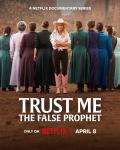
I’ve seen a lot of commentary online about the recent Netflix documentary, Trust Me: The False Prophet. It details the rise and fall of Samuel Bateman, a self-proclaimed successor to Warren Jeffs in the FLDS church1. It follows on the heels of Keep Sweet, Pray, and Obey of a few years ago that documented the downfall and arrest of Warren Jeffs himself.
I’m not going to discuss the details of either of those series except as it pertains to some larger issues I think we need to understand. And while some of the things I have to say may come across as negative to faithful members of the mainstream LDS church2, I want to make it clear that nothing I say here (or in any of my blog posts to date) suggest you should leave the church. The best people I’ve ever known are Mormons3 and it’s undoubtedly the case that many people are able to improve their lives through teachings of the church.
With that, let’s dig in.
I think there is value in every person of faith watching documentaries such as these, especially if you are ‘certain’ in your conviction, and even more especially if you are mainstream LDS.
One thing that will probably shock you in these documentaries is how easily paedophilia became accepted practice amongst the higher-ups. Many, or even most, of the every day members of the FLDS church didn’t know about it, and many still don’t believe it because they also find it horrific (more in a moment on this point), but those in power seemed to feel it was perfectly acceptable.
We are familiar with the aphorism, ‘Absolute power corrupts absolutely’, and if you’re LDS you are probably familiar with the scripture that, ‘… it is the nature and disposition of almost all men, as soon as they get a little authority, as they suppose, they will immediately begin to exercise unrighteous dominion.’ (D&C 121:39)
I love this quote, allegedly by Frank Herbert, author of Dune, ‘Power attracts pathological personalities. It is not that power corrupts, but rather draws those already prone to corruption.’
I’m inclined to believe both. Power draws those who are already corrupt, because they see it as a way to get away with all of their basest desires. And it also corrupts, especially if you believe you’re called by God, because people practically worship you and everything you say. It then becomes so easy to believe in your own hype, and to believe that whatever you want or desire, anything that pops into your mind, comes from God – after all, if it was wrong He’d get rid of you, right? No checks on power leads to rampant abuse of that power – it’s just the nature of humanity. This is exactly what we see with Samuel Bateman and Warren Jeffs.
And yet despite the horrific acts they perpetrated, acts proven in a court of law, believers still maintain these men are prophets of God. Some people say the proven acts are lies. Others accept the acts happened, but say they were commanded by God, so can’t be wrong, no matter how they look to us.
And they say these things with absolute conviction. It is clear they really believe.
That should make every one of us sit up and take notice. It should make us ask the question, ‘What are the things I say with that same level of conviction?’ And then follow that up with a further question, ‘Could I be just as wrong as they are?’
What we see in these documentaries is, in many ways, a reflection of life in 19th century Utah. While there has undoubtedly been evolution in the practices of these communities over the decades, their practices more closely align with those of the Mormons under Brigham Young and John Taylor than do those of the mainstream church today.
Indeed, after a century of denying the document existed, the LDS church recently published the ‘revelation’ church president and prophet John Taylor received in 1886 which states that the law of polygamy would never be done away with in this life. The revelation includes the all-important phrase, ‘Thus saith the Lord’, making it clear the prophet of the day was declaring it a revelation from God. There is evidence that John Taylor ‘gave authority’ to individuals outside the hierarchy of the church so that polygamy could continue in the event that the church officially stopped the practice after his death. This is precisely where the FLDS and AUB claim their authority comes from.
While it’s true that marrying a 13 or 14 year old wasn’t illegal in most of 19th century America, it certainly wasn’t common, and was considered at least improper. In short, society at large considered it pretty disgusting then, just as now. And, of course, polygamy was illegal, so we can’t get behind the ‘but it was legal to marry someone that young’ argument anyway. In that sense, the ‘ick’ feeling we get when we watch these documentaries should apply just as much to our own LDS heritage as it does to these polygamous communities today.
There are also countless stories of 19th century polygamous wives and their children being left destitute and to fend for themselves, and many many stories of physical abuse. There are no good fruits of polygamy, and as I’ve previously written, it has never been a righteous practice.
That there are today so many who willingly suffer persecution and hardship because of their firm belief it comes from God – just as there were so many that did the same in 19th century Mormonism – tells us something about belief, and about how we can truly feel the ‘Holy Spirit’ has confirmed to our hearts something that is simply not true. If you haven’t read my series about discerning truth from falsehood, see that here. It is increasingly becoming my belief that gaining this discernment is one of the most important things we can do in this life.
Now, frankly, Brigham Young didn’t just get this wrong. He got an awful lot of things wrong. But as I’ve said previously, this doesn’t automatically make the church not the Lord’s. Remember ancient Israel went through many periods of unrighteous leaders and false prophets while still being the Lord’s covenant people. It’s possible to be personally true to the Lord and to stay in the LDS church regardless of history4. Anciently, the Lord eventually raised up prophets to call His people to repentance, and He will do the same for His people today.
I’ve seen people refer to the Samuel Bateman group as, ‘a cult within a cult’, as most FLDS didn’t believe him. And I think it’s worth speaking briefly about cults.
The word ‘cult’ is emotionally charged, which is unfortunate. The word ‘cult’ doesn’t strictly refer to anything weird or dangerous. It just refers to a specific group of people doing things that separates them or identifies them. It’s where the word ‘culture’ comes from. Technically, all religions are cults. Political movements are cults. Social movements are cults. Even an employer can be a bit cult-like. So if someone says you’re in a cult, so what? Everyone probably belongs to multiple cults in one way or another.
Of course, that’s not what most people mean when they use the word today though. When someone says, ‘You’re in a cult’, they usually mean something that is dangerous, manipulative and controlling; something actively harmful.
The most common definition of a cult I’ve come across is the BITE model by Steven Hassan. Steven himself was a member of the Moonies cult and is a genuine person trying to help people think for themselves rather than be controlled by others. You don’t need to agree with everything he says to recognise there is a lot of truth in what he teaches.
If you’d like to assess your own experience with your religion (or political group, or workplace), you can take a free test to see how ‘cult-like’ your organisation is, based on the BITE model. What’s curious is that two people from the same organisation/religion can take the test and come to different conclusions. One person may have been raised in a very strict household with a lot of orthodox rules and harsh penalties, while someone else’s parents maybe took a less controlling approach to parenthood. In the LDS world, you might have grown up with a harsh ecclesiastical leader who wouldn’t declare you ‘worthy’ if you drank a caffeinated drink, while someone else had a Bishop who didn’t mind if they drank an occasional cup of coffee (yes, these opposites do exist)5.
In other words, you might have experienced the church as a highly controlling cult, while someone else experienced it as no more than a place where good teachings are found which will help you live a fuller life.
The Netflix documentaries I’ve referenced in this post both show religious communities that exhibit too many examples of harmful and dangerous cults for my liking – certainly more harmful than the mainstream LDS church. Organisations such as Scientology would also fall into the category of more harmful than the LDS church6. I think it’s possible to listen to General Conference talks that make the church sound very cult-like, while other talks in the same Conference emphasise our free will and agency.
The issue, I believe, comes back to control and accountability. We can’t delegate accountability for right and wrong to another mortal. I don’t believe that when we get to the pearly gates the phrase, ‘but the prophet told me to’ will be considered a good enough excuse for doing something wrong. There have been far more false prophets than true ones throughout history and today. God has given us a conscience and intelligence and, in today’s world, a mountain of information that He expects us to use when determining what comes from Him; in discerning between right and wrong.
So, if a religious leader says, ‘You must only wear …’, do your own work to discern what God is happy with in your life. If a man says, ‘You can only eat …’, study it yourself using all the tools of discernment and see what God tells you. You might come to exactly the same conclusions as the man at the head of your religion tells you (or not), but you’re now doing it because of your own independent study and searching. You have chosen to do it, not because someone else is controlling you or brainwashing you into it. Any time any religion tries to take away your own free will and agency, they are acting in a harmful cult-like way. God wants our heart. He wants us to choose Him, not to be pulled along in a chain-gang.
© Copyright Jeffrey Collyer, 2026
- The FLDS – or Fundamentalist Church of Jesus Christ of Latter-day Saints – come from those who continued the practice of polygamy when the mainstream church abandoned it officially in 1890 (although in practice they didn’t abandon it until the 1910’s). Another splinter group known by some is the AUB, or Apostolic United Brethren. There are many more such groups, but these are the main ones of which I’m aware.
- By ‘mainstream’ LDS or Mormons, I mean members of The Church of Jesus Christ of Latter-day Saints, headquartered in Salt Lake City, Utah.
- Indeed, I’m still technically a Mormon, although I don’t practice everything the church teaches and am at the very least ‘nuanced’.
- Both LDS and the Catholic Church believe the issue of the ‘true’ church relies on keys or authority – not on the righteousness of leaders. If Peter truly passed the leadership of the universal Christian church to Clement of Rome, then that authority remains with the Catholic Church today, regardless of some of the truly horrific abuses of Popes in the church’s history. If, on the other hand, Peter didn’t pass on those keys to Clement, and he instead restored them to Joseph Smith, then the keys and authority remain with the successors of Joseph Smith, regardless of their own righteousness.
- If you’re not familiar with Mormonism, a caffeinated drink and a coffee might sound very similar, but to a faithful Mormon they are a world apart. Coffee is strictly prohibited by today’s interpretation of the ‘Word of Wisdom’, regardless of caffeine content, while high caffeine energy drinks are perfectly acceptable.
- That said, the recent lawsuit against the Mormon Stories Podcast appears to be purely punitive in a way that mirrors how Scientology deals with those who oppose them. I desperately hope this is not where the LDS church is heading.
 All Things Witness