

Many years ago in another part of the world, I was serving in a calling that required me to be in contact with many church leaders around the Stake. On a particular Sunday evening, I needed to make contact with several individuals and picked up the phone (this was before the days of mobile phones, text messaging and the internet). I specifically recall ringing one house, where the Bishop I spoke to was very polite on the phone. In the background, however, I heard a member of his household say, ‘What’s he doing ringing you now? Doesn’t he know the World Cup final is on?’
Continue readingTag Archives: Sacrament
What’s in a Name?
This continues the series discussing the LDS ordinance of the sacrament. To see the previous posts in the series, see here
As we continue our pondering of the Sacrament prayer wording, it’s important to pause and consider in some detail the Name of Christ. In the prayers, the Priest asks, ‘God the Eternal Father … in the name of thy Son, Jesus Christ…’ to bless and sanctify the sacramental emblems. It’s easy to overlook this, because in the LDS Church we close every prayer, every testimony, every talk/sermon, every lesson, ‘in the name of Jesus Christ, Amen’. It’s become a custom, one could almost say a habit.
That’s unfortunate, because there is great power in the Lord’s Name, and we miss out on that when we’re not deliberate and reverent. Indeed, we may well be breaking the third of the great commandments given at Sinai, ‘Thou shalt not take the name of the Lord thy God in vain…’ (Exodus 20:7). It’s this commandment I’d like to focus on in this post.
Continue readingTaking His Name
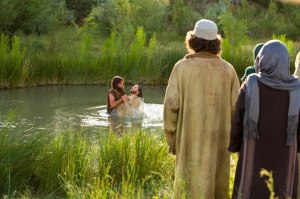 This is a post I’ve been meaning to write for a good long while, probably about 2 years. Originally, I was going to write it as we approached a General Conference of the Church – and I might still do that sometime – but for this article (and the next couple) I’m going to focus on the sacrament.
For those who have been following, this is the 11th article in my series on the sacrament of The Church of Jesus Christ of Latter-day Saints. I was going to discuss taking the name of Christ a bit later in the series, but the phrase is referenced in both of the sacrament prayers – twice in the first – and it’s worth thinking about throughout the ordinance.
Let’s look at the prayers again, this time focusing on where the name of Christ is referenced. Continue reading
Of Becoming a Saint
 This post continues my series on the Sacrament. And don’t worry, I’ll get to it. But there’s something important (and surprisingly relevant) I need to discuss first.
As you might know, I’m LDS. If you’re not LDS – or perhaps don’t even know what that means – you might know members of our church as Mormons.
When the church was newly organised back in the early to mid 19thcentury, the term Mormon was used first by enemies of the church and was considered derogatory. But over the years, the word became more widespread. Continue reading
Endowed with Power
 The Sacrament is such a beautiful ordinance. In previous posts, I’ve already talked about how each element of it reminds us of Christ. In so many ways it draws us to Him. The bread, broken that we might eat; the water/wine, poured that we might drink. These things remind us of His body willingly broken, and His blood freely spilt, that we might be made whole.
Likewise the table, the cloth, the priests, and more, all remind us of Him and the grace He so fully offers us. The prayers themselves are no different, and offer us a far greater opportunity to ponder His wondrous sacrifice than perhaps we realise.
In the next couple of posts, I’ll be sharing my thoughts and feelings on that short phrase appearing early in both prayers, “to bless and sanctify”. Continue reading
A Man of Sorrows

In my last post, I talked about sadness – and my own lack thereof – and how it is a necessary part of our life, ultimately allowing us to receive a greater happiness.
I thought at the time that it was a distinct topic from my series on the sacrament (you can read the posts in that series here). But as I sat in church today listening to the sacrament prayers, I realised that wasn’t the case. Obviously, all gospel topics are inter-related in some ways, but this was more so than I had imagined.
To bless and sanctify. Bread and Water. Emblems of His death and suffering. To our souls. Hmm.
Two Prayers
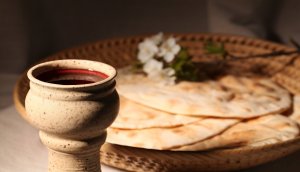 When I started this series about the LDS ordinance of the sacrament, I thought it would take me two posts to cover the sacrament prayer. As I sat down to dissect the prayers into areas I wanted to cover, however, I realised that it was going to take longer than that. So this is the first of, well, several short articles about the sacrament prayers themselves. If you want to see a list of all of the topics on the sacrament covered so far, go here.
As I’ve said before, the prayer on the sacrament must be word perfect. Any mistake must be remedied, and the Priest will repeat the prayer until every word spoken is correct. I love the symbolism of that.
Yes, we are commanded to be perfect even as the resurrected Christ, or His Father in Heaven, are perfect (3 Nephi 12:48). But we can’t actually achieve that. Not any of us. We all make mistakes and transgress the laws the Lord has given us.
But that’s okay. Because of the atonement of Christ, the emblems of which are displayed on the sacrament table, we can all partake of His grace, repent, and start again. No matter how many times we’ve failed, we can try again. Thus, even with our imperfections, we can keep this commandment by being “perfect in Christ” (Moroni 10:33).
Indeed, we can only obey this commandment to be perfect through our Saviour and Redeemer, and the requirement for perfection in the prayers on the sacrament is a beautiful metaphor for that. Continue reading
They Did Kneel Down With The Church

Image © Copyright Intellectual Reserve, Inc
This post is part of my series about the LDS ordinance of the sacrament. In my previous posts I’ve discussed the table, the cloth covering and the Priests. For those articles, as well as to see what else I’m currently expecting to write in the series, go here.
When Jesus introduced the sacrament amongst His Jerusalem apostles, Matthew tells us that He “blessed” and “gave thanks” for the bread and wine. He then offered it to His disciples. (Matthew 26:26-27) A single blessing or thanks, one for the bread and another for the wine, and then each of the men with Him partook of it.
If you stop and think about it, that’s really interesting, because it is so unusual. Most other LDS ordinances are very much one to one. Baptism: a single prayer for a single person. Confirmation: a single prayer for a single person. Priesthood ordinations: a single prayer for a single person. Etc. We have many communal worship experiences. Not so, with ordinances.*
Indeed, for the sacrament, it seems that the communal experience is an integral part of the ordinance. Moroni tells us that those ministering the Sacrament, “…did kneel down with the church, and pray to the Father in the name of Christ…” (Moroni 4:2, emphasis added. See also D&C 20:76)
The question we must ask ourselves is therefore why the communal experience is so important. Continue reading
Beautiful Irony
© Copyright, Intellectual Reserve International
This is the fifth post in my series about the LDS ordinance of the sacrament. All the previous posts can be found here. So far, I’ve talked about how the sacrament table serves as an altar for us today here, and the many wonderful symbolisms the white cloth covering the sacrament represents here and here.
When Christ introduced the sacrament, Matthew tells us that, “Jesus took bread, and blessed it, and brake it, and gave it to the disciples…. And he took the cup, and gave thanks, and gave it to them…” (Matthew 26:26-27)
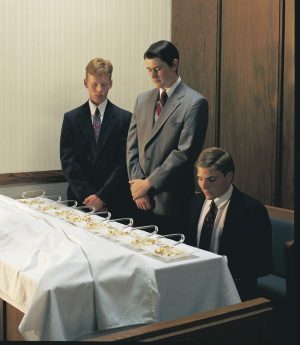
I’ll be discussing the bread and wine/water in later posts. Here I want to focus on those who represent Jesus in this ordinance – the Priests (or Melchizedek Priesthood holders).
It was a couple of years ago now that I was pondering the sacrament and suddenly realised the beautiful irony in its blessing. That the Priests represent Christ is generally well understood. Indeed, in any instance where the Priesthood is being used, the one doing so represents our Saviour.
But there is something special about it in the sacrament. You see, in this ordinance the Priests don’t only bless the emblems of Christ’s atonement: they are also the ones who break the bread. Think about that. Continue reading
Concealing and Revealing

The ark of the covenant was considered a sacred item of great power amongst the Israelites. It’s normal place was in the Temple, behind a veil, in the Holy of Holies
This is the 4th post in a series about the LDS ordinance of the Sacrament. You can find the list and links to all of the articles in the series here.
In the last article, I discussed the white cloth used to cover the bread and water sitting atop the sacrament table. Just as the emblems of Christ’s atoning sacrifice remain covered – completely hidden – beneath the cloth until the moment they are blessed and passed to us, so Christ’s mercy and grace is hidden from us until the very moment we need them. Not the moment we think we need His help. Rather, the very moment He knows we need it.
I love that symbolism, but there is more to the sacrament cloth than that.
On the Sunday morning of Christ’s resurrection, the apostles Peter and John ran to the tomb after hearing Mary’s witness. When Peter entered the empty chamber he found the linen clothes used to wrap Jesus’ body, apparently simply left where they were when Jesus rose.
Not long ago, if you’d asked me about the state of those linen clothes, I would have said they were folded neatly. But they weren’t – at least the Bible doesn’t say they were. In fact, only one part of the linen clothes had been folded and carefully placed:
“And the napkin, that was about his head, not lying with the linen clothes, but wrapped together in a place by itself.” (John 20:7, emphasis added)
I find it really interesting that it was only the cloths covering the Saviour’s head that had been folded neatly. He was happy to leave the fabric covering His body where it was, but took especial care with those that had covered His head. There must be a reason for that. And the fact that the apostle John specifically references this is unlikely to be accidental. What was so special about the head cloths? Continue reading
 All Things Witness